Empowering shea butter producers in Ghana
In northern Ghana, the production of shea butter provides a livelihood for thousands of women and their families. However, the work is physically demanding and time-consuming and limits the women’s earning potential. This is where the diaspora organisation African Ally and its partner organisation, Freeworld International, come in.
Profile
- Name of the diaspora organisation:
African Ally e.V. (2020)
- Partner country:
Ghana
- Head office of the organisation:
Berlin-Spandau, Germany
- Website:
- Partner organisation in Ghana:
Freeworld International
- Funding period:
2024 - 2025
Community engagement in Germany and Ghana
African Ally e.V. is a diaspora organisation that strengthens development cooperation by connecting diaspora communities with partners in Germany and Africa. Through dialogue, partnerships and community-driven initiatives, the organisation promotes sustainable livelihoods, education, skills development and environmental stewardship in disadvantaged communities in Africa.
By facilitating knowledge exchange, capacity building and vocational training, African Ally empowers individuals and communities while fostering equitable collaboration between diaspora actors, governments and civil society. It also leverages the expertise, networks and commitment of the African diaspora to contribute to long-term socio-economic development.
In Germany, African Ally empowers migrant communities by fostering dialogue on anti-racism, strengthening engagement with public institutions, and providing civic education for youth.
Why is African Ally e.V. involved in Ghana?
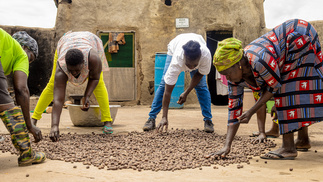
Hard work: the women in Pusu Namogo are sorting the shea nuts.
The shea tree is a vital source of food, medicine, and cosmetic products in Ghana, while also providing an important source of income for many women in rural communities. However, the production of shea butter is a lengthy and largely manual process, which often constrain the productivity and income of shea producers. This is no exception for the women in the Puso Namogo community, in the Upper East Region of Ghana. From harvesting the shea fruits, to preparing the nuts for processing them into butter, the different phases of production remain labour-intensive and physically demanding for women.
To render the shea butter production more efficient, African Ally e.V. has partnered with the local organisation Freeworld International. Together, they launched a joint project to support the women of the Akoma Cooperative Women Association in Pusu Namogo by addressing the challenges they faced in their shea butter enterprise while strengthening their participation in local decision-making processes.
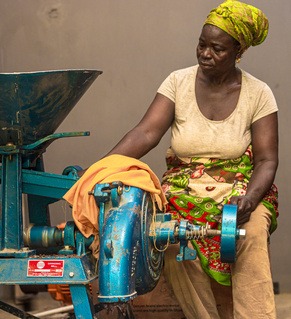
Through funding of GIZ's programme 'Shaping development-oriented migration' (MEG), the project allowed for the purchase of 5 machines that mechanised the processes of shea butter extraction including washing, crushing, roasting, milling, and kneading, which greatly reduced the women's manual workload. Complementing this support, African Ally also provided funding to rent a temporary facility to house the machinery, as well as to cover the wiring, renovation, and installation required to make the equipment operational.
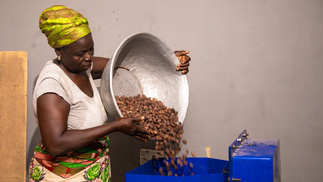
For the first time in Pusu Namongo, it is possible to grind shea nuts mechanically.
Furthermore, the shea producers received training in the safe operation of the machinery, as well as in leadership, cooperative management, financial literacy and livelihood diversification. Combined with the acquisition of the new equipment, these skills enabled the women of the Akoma Cooperative Women Association to scale up production, strengthen their economic self-reliance, and meet the growing demand for shea butter.
Shared successes
The project transformed the cooperative's production capacity, reducing the time required to process 75 kg of shea nuts from five days to just five hours. By the project's completion in 2025, the cooperative had assumed full ownership of its operations. For the women of Pusu Namogo, this is more than just shea butter. Its's a source of empowerment and a more secure future for them and their families.
Further information on the offers available to the Ghanaian diaspora can be found below.