Diaspora Summit 2026: Co-creating the future beyond 2030
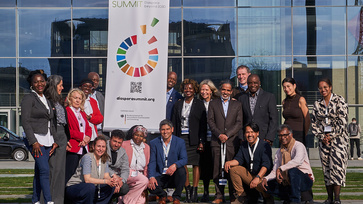
This year’s Diaspora Summit proved to be another crucial event, gathering diaspora changemakers from different parts of Germany, policymakers and partners in Berlin to discuss the future beyond 2030 and how to achieve it together. With over 22 million people in Germany having a migration background, the summit aimed to move from visibility to participation and from participation to shared solutions.
We live in an age where we need the skills, experiences and perspectives of as many people as possible. We have created a space where people with different experiences, backgrounds and perspectives could come together,” shared Rafael Sánchez-Moreno, co-organiser of the summit ahead of the event.
The conversation began in March with digital warm-up sessions exploring topics such as social entrepreneurship and the influence of the diaspora on public life. In April, the summit kicked off at the Bundestag, focusing on building trust and fostering a structured dialogue between the diaspora and politics. Further exchanges were hosted at the Federal Ministry for Economic Cooperation and Development (BMZ). Here, discussions went deeper into how institutions and diaspora organisations can align efforts.
The last section of the summit was held at the Berlin Global Village, bringing everyone into one room for a keynote by Martin Russel, a talk show and a lively market where ideas found partners and next steps were defined. Additional workshops helped explore how to strengthen organisations, scale social businesses and build lasting global partnerships. Throughout, one insight kept coming back: people get involved when they feel seen, needed and included. The summit made it clear that the role of diaspora actors as strategic partners needs more attention in the current geopolitical situation. Participating organisations are now working to maintain structured dialogue, explore joint projects and continue peer learning.
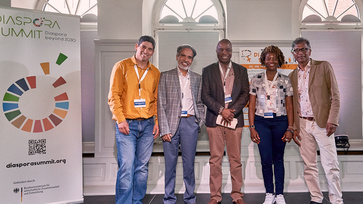
Fittingly, the summit was organised by diaspora actors themselves—including Edith Otiende-Lawani, Akinola Famson, Rafael Sánchez-Moreno, Shiva Adhikari and Mohan Dhamotharan. Their engagement reinforced one of the summit's central messages: diaspora actors are not just a target group but co-creators of shared solutions.
Among them, Rafael and Shiva are members of the Diaspora Advisory Board (DAB), an advisory mechanism mandated to include strategic insights from the diaspora into GIZ’s global programme ‘Shaping development‑oriented migration” (MEG).
On behalf of BMZ, MEG helps connect the dots: it brings together various actors such as diaspora and policymakers so that dialogue turns into cooperation for sustainable development. The Diaspora Summit 2026 was financed by the BMZ through MEG.
More about the summit: