Bringing Diaspora Voices to the Global Stage
The IMRF as a Global Platform
The International Migration Review Forum (IMRF) serves as a key global space where states come together to assess progress on the implementation of the Global Compact for Safe, Orderly and Regular Migration (GCM). In a period marked by growing political polarisation, the IMRF provided something increasingly rare: a room for dialogue, shared reflection, and collective direction on migration governance.
Yet beyond intergovernmental exchange, a central question persists: how can those most affected by migration policies be meaningfully included in these conversations? The people the GCM seeks to protect, including migrants themselves and their transnational communities such as the diaspora, are often still underrepresented in formal policy spaces. The 2026 IMRF in New York saw the German delegation joined by a special participant: Rania Kinfe, Chairwoman of the Ethiopian Diaspora Women's Association (EDWA). Invited by BMZ, she helped ensure that diaspora voices were brought to the policy table, contributing valuable diaspora and civil society perspectives to the forum.
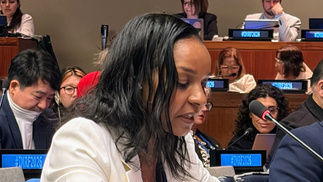
Rania during the Multi-Stakeholder Hearing
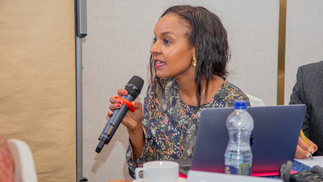
Rania Kinfe, Chairwoman of EDWA
Turning Recognition into Partnership: Diaspora Voices at the IMRF
An important theme emerging from IMRF discussions is the growing recognition that diaspora communities are not only observers of migration systems, but active participants shaping them across borders. While many states are developing structured approaches to include diaspora contributions, diaspora representatives consistently emphasise that inclusion must go beyond formal recognition. Rania’s contributions to the IMRF, as one of the few representatives of diaspora civil society within national delegations, brought this tension between lived experience and policy frameworks into sharp focus.
The forum gave me a stage to represent diaspora voices and civil society. It became something much bigger than only our Ethiopian women’s association.
Her participation extended across multiple formats, including interventions at the Multi-Stakeholder Hearing and at a roundtable discussion on strengthening regular migration pathways, among other events. These spaces allowed for direct exchange with policymakers and non-state actors. Rania leveraged the increasing visibility of the diaspora to highlight the need to institutionalise diaspora engagement in policy processes and to structurally include the diaspora as a meaningful partner in migration governance.
Drawing on EDWA’s work with women and diaspora networks across African communities, she raised concerns around increasing returns from European countries and resulting challenges of dignified return and sustainable reintegration. She advocated for the recognition of diaspora actors, in particular women, as equal partners in co-creating solutions to such challenges and in shaping policy responses across the entire cycle of migration, spanning countries of origin, transit and destination.
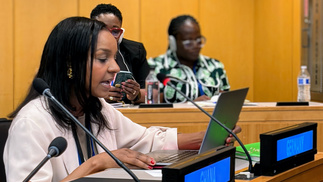
A moment from Rania's reflections on diaspora engagement
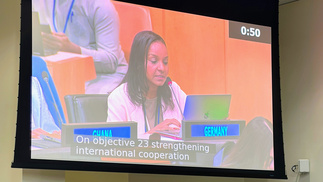
Rania's intervention at the Roundtable
Between Momentum and Ongoing Challenges
Throughout her participation in the Forum, Rania highlighted several positive developments in global dialogues such as the IMRF. She was encouraged to hear how migration was framed not as a burden, but as a form of enrichment, with the socio-economic and cultural contributions of migrants backed by data and evidence.
Most importantly, there are signs for a gradual shift towards seeing diaspora actors as active stakeholders with expertise, practical knowledge and agency. Rania pointed to ‘promising approaches’ where diaspora structures have been embedded within formal institutions, such as the Ethiopian Diaspora Service (EDS) and Ghana’s Diaspora Affairs Office, Office of the President (DAOOP), which work in partnership with actors like GIZ to channel diaspora expertise and contributions into development processes. Furthermore, EDWA, which was established in 2024, has built strong relationships with governmental and institutional actors both in Germany and Ethiopia and has become part of relevant cooperation and dialogue structures.
Despite this growing momentum, representation and visibility within institutional spaces have not translated into structural change, with diaspora engagement in global forums such as the IMRF remaining uneven and fragile. Rania described the German delegation’s support as ‘unbelievable’, noting how meaningful inclusion can strengthen confidence and impact, but also observed that such practices remain the exception. Germany and Canada were among the few delegations to include civil society representatives, highlighting both progress and the lack of consistent approaches to participatory mechanisms across states. Moreover, a significant number of civil society actors and stakeholders were unable to be present in the room, due to visa constraints and limited capacity for participation. In her view, this falls short of the ‘whole-of-society' principle of the Global Compact for Migration, raising important questions about the inclusiveness of current migration governance processes.
The growing strength of diaspora networks and their increasing cooperation with government partners signal important progress, yet, as Rania observed, ‘we’ve built something important, but it still feels fragile.’ The challenge ahead lies in transforming this emerging momentum into durable structures that can sustain and deepen diaspora participation over time.
GIZ's Role in Bridging Diaspora and Policy
The efforts of the Federal Ministry for Economic Development and Cooperation (BMZ) were a key factor to enable the diaspora to participate in the IMRF. On behalf of the BMZ, the GIZ Sector Programme (SV) on Migration and Development organised the selection and entry process for the diaspora representatives to join the German delegation and provided support to them on the ground. The networks of the GIZ programme ‘Shaping development-oriented migration’ (MEG) were utilised, amongst other things, to establish contact with diaspora stakeholders. For many participants, such support structures are not merely logistical but foundational, providing the continuity needed to engage effectively in spaces that might otherwise remain out of reach.
MEG understands both sides, the diaspora and the political landscape. It builds the bridge between them. Without that, many of us are left between two worlds.
The future development of these support frameworks remains an important area of reflection. As discussions continue on the future of diaspora programmes, there is a growing interest in how the enabling mechanisms established by programmes such as MEG can be further strengthened.
As Rania highlighted, the continuity of such support has been instrumental in building visibility, networks, and long-term engagement for diaspora organisations, helping to connect community realities with policy processes in meaningful ways. Preserving these connections will be essential to ensure meaningful diaspora engagement over time.
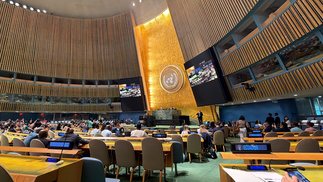
The UN General Assembly Hall in New York
The IMRF shows how much global migration governance depends on spaces where international dialogue is possible, and diverse voices can be heard. As reflected in Rania's experience, participation in forums like this does more than open doors: it enables lived experience to inform policy, lends credibility to underrepresented voices, and strengthens the legitimacy of migration governance itself.
Yet the challenge ahead remains whether this growing momentum can be translated into institutional practice. Without this shift, inclusion risks remaining exceptional rather than becoming an integral part of migration governance, missing the unique perspective that diaspora actors can bring to policy processes. Diaspora actors like Rania demonstrate what becomes possible when those bridges exist. The task now is to ensure they are no longer dependent on ad-hoc efforts but become a permanent part of how the landscape of global migration governance is shaped.